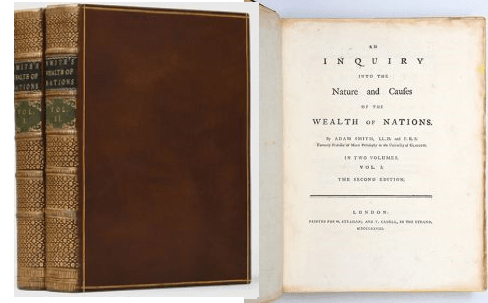
A pioneer who is now outdated
Adam Smith made a pioneering contribution to economics. The Wealth of Nations published in 1776, combines a coherent theory of the economic system with a multitude of practical details and observations 1.
However, much of Adam Smith’s thought is either out of date or no longer relevant. The Wealth of Nations was a notable contribution in the 18th century, but it should not be used for understanding the modern economy
Trade
The foundation of prosperity
The first four chapters of Book 1 lay the foundations for Smith’s system of economics. According to Smith, human beings are distinguished from all other animals by their ability to “truck and barter” 2. This ability enables individual workers to specialise in the production of particular goods, because they can exchange their products for goods produced by different workers. E.g. the butcher exchanges meat for the bread supplied by the baker. (Chapter 2)
Specialisation enables people to be more productive because each person only performs one task in which they become expert. (Chapter 3) Smith gives the well-known example of the pin factory. However, exchange requires the use of money discussed in detail in Chapter 4 and in webpage.
Class
Smith does not use the term “class” but a three tier division of society is at the heart of his economic analysis.
Unskilled labour at the bottom of the economic pyramid,
The basic wage for unskilled labour is set by the cost of feeding and housing a family at a minimum level. The wages of unskilled labour would be just sufficient to enable enough chlldren to grow up to meet the demand for labour. If the number of children reaching working age was high (low), then there would be a labour surplus (shortage) and wages would fall (rise) until the childhood mortality limited (increased) the labour supply and wages were forced up (down) again. The wages for skilled workers and people doing unattractive or irregular work are determined by a mark-up based on the wages of unskilled labour.
Smith’s theory of wages may well have been a realistic reflection of the situation in the 18th century when childhood mortality was high. But it would no longer be considered ethically acceptable today.
Small Businesses and Farmers
Hope for growth
Smith pins his hopes for development and wealth on small business owners or farmers. According to Smith, these are the people who know their business, farm or craft. They will invest to increase their income and the general prosperity. They not only have the knowledge of what can be improved, they also have a personal interest in their businesses. Their plans for the future rely on increasing the productivity and prosperity of their enterprises.
Great landholders, rulers and the state
Only interested in prestige and war
Great landholders have little interest or ability to develop their land as a source of production. In the centuries of chaos and warfare, following the end of the Roman Empire, powerful landlords were needed to provide defence for the majority of the population. In a mainly agricultural society, rich men had little opportunity to spend their wealth, except on prestige, the defence their landholdings and conquering neighbouring lands.
In the 18th century, the state was just the greatest of the personal landholders. Almost all states were kingdoms, ruled by one powerful family. England’s American colonies were fighting for the right to become a republic. Smith believes the development of Europe depends on the growth of smaller-scale farmers and craftsmen who have the motivation and knowledge to create new machinery and methods of production.
Prices and Factors of production
Book 1 Chapters 8 – 10 define 3 sources of income and cost (the factors of production). Wages are paid for labour. Interest is paid for capital (Smith uses the term Stock). Rent is paid for land.
Chapters 5-7 of book 1 discuss how prices are determined. Smith’s approach would now be considered out of date. Modern economists would suggest that Smith gives too great an emphasis to the role of labour and does not sufficiently allow for the effects of demand on prices.
What has changed
There have been many changes since the 18th century. Large parts of Smith’s analysis are outdated because of changes over the last three centuries
- Smith scarcely mentions the use of coal, oil and gas to replace human labour with machines. This has been the major cause of increased production over the last three hundred years
- Modern forms of limited liaibilty company were created in English law in the mid 19th century. Smith doubted their value (Book 5 Chapter 1 part 3). He wrote about “patient” investors who were committed to an enterprise over the long term rather than the modern stock exchange which often has a much more short-term concern for quick profits.
- Smith’s division of society into three groups of economic actors seems simplistic by modern standards. It does not take adequate notice of non-physical assets, such as brand awareness and does not include managerial activities.
- Democratic governments today are more complex, more sophisticated and more democratic than 18th century governments
Outgrowing Adam Smith
Smith’s economic analysis described above formed the basis of Smith’s “System of perfect freedom”. It remains the basis of many wide-spread economic ideas today. (Quote from Keynes) We need to outgrow these old inaccurate theories in order to plan a better future for our children.
This website leaves me wanting to know more. It is clear to me that our current economic system takes no…

Where next?
You can find out more about why a new economics is urgently needed or find more suggestions about Developing a New Economics. Or you can go to the home page or the map of this website .
References
- There are many publications which cover Adam Smith’s thought as a whole and in more detail than is possible here. (reference to publications)
- Book 1 Chapter 1
- Findlay R & O’Rourke K.H. (2007) Power and Plenty Pronceton Univerity Pres, Princeton
 Outgrowing Adam Smith
Leave a comment