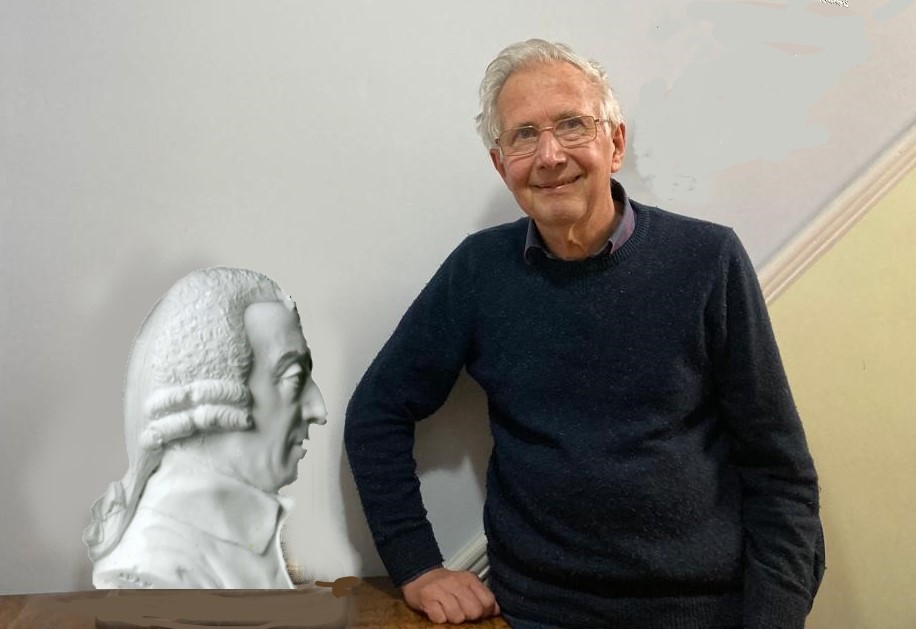
A new economy for the 21st century
- A critical evaluation of Adam Smith’s ideas
- Explaining why these ideas are out-of-date
- Economic and monetary policy for the 21st century
Adam Smith was an 18th century intellectual. He is best known for his book “The Wealth of Nations” published in 1776. This is often considered as the foundation text for economics. He also wrote another book entitled “The Theory of the Moral Sentiments”.
Adam Smith’s economic ideas remain influential but the world has changed since he wrote. We have outgrown Adam Smith’s economics. Adam Smith himself described “The Wealth of Nations” as “ a violent attack upon the commercial system of this country”. In other words, it advocates for Smith’s ideal economic system. It does not describe the economy that actually existed.
Adam Smith’s ideas originated in the 18th century. They may have worked well enough as a guide for the 19th century in combination with the Gold Standard and the British Empire. In the 20th century, Smith’s ideas began to seem out-of-date. J.M. Keynes’s innovations helped to provide a period of comparative prosperity in the middle of the century. At the start of the 21st century, Smith’s ideas are inadequate. They are based on a less populated simpler world. They are not appropriate for the crowded, complex, energy intensive world we live in today. We have outgrown Adam Smith and we need some new ideas.
Economics – an ideology
Many economists like to think of their subject as an impartial science. But, in reality, economics promotes a distinct set of ideas originating with Adam Smith. These were ideas of the 18th century. They reflected a distrust of the autocratic and monarchical governments of that time and a belief in the growing power of individual enterprise. They include
- mistrust of government
- The belief (sometimes wishful) that the economy can be self-regulating
- A split and divided attitude to money
- A reluctance to distinguish between different forms of economic activity.
- Little appreciation of the causes and effects of inequality of wealth or income
Adam Smith’s ideas helped to create an exploitative economy, though that was not his intention. They may have worked well enough in the age of colonies and empires; though they were unfair to colonised peoples. Now, the exploitation promoted by current conventional economic thinking is unsuited for a world that is exhausting natural resources. It also does not meet the expectations of today’s moral values.
The world has changed since 1776
There are more of us
The world’s human population has grown by a factor of 10 from about 800 Million in 1780 to 8,000 million in 2022. The world economy has grown even faster than the population. Human buildings and farming extends further and covers much of the habitable area. We use more energy. James Watt’s version of the steam engine was invented at about the same time as Smith was writing. We face entirely new challenges to limit our effect on the natural world and preserve the essentials for life.
We live in a more sophisticated and complicated world
Our institutions and civilisation is more complex and fast-moving than would have been possible in a world dependent on horse-riding for communication. At the same time, the institutions of government have become more diverse, more complex but also less hierarchical than the world envisaged by Adam Smith.
Adam Smith’s economics is out of date. We urgently need a new type of economics to guide us as we face the challenges of the 21st century. Outline of the site
Where next?
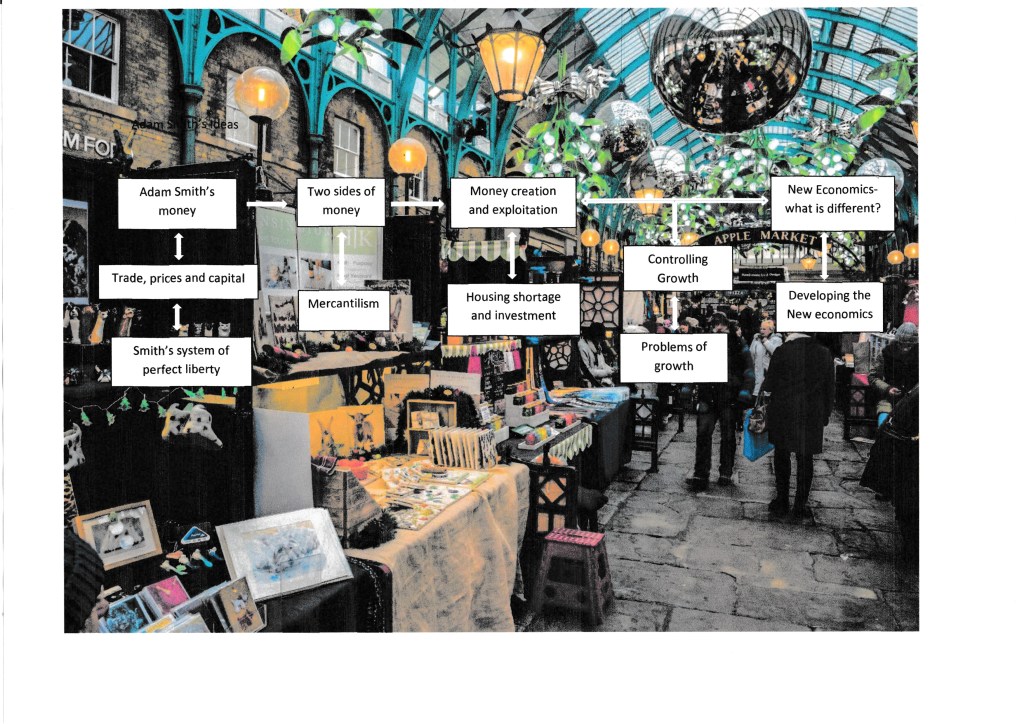
The pages of this website are intended to stand on their own, please choose your own route through them. If you prefer a suggested route, based on an historical order from Adam Smith to today, you could follow this list. The links will take you to the pages that exist at present. Page names without links indicate pages that are planned in the future.
Alternatively, some people will prefer to start from the present day. In this case, you could start from “A New Economic and Monetary System” and follow the route below in reverse.
- Adam Smith’s ideas; Trade, class and capital, Adam Smith’s money, Smith’s system of perfect liberty
- Money and economics; Mercantilism
- Money creation and exploitation; Housing shortage and investment
- Controlling Growth, Problems of growth
- A New Economic and Monetary System ;Developing the New economics
Additional pages: to be added in the future:
- Money before Smith; Money from Smith to the present
- Inflation
- Keynes General Theory and Bretton Woods
- Inequality
- The challenges of the future (limits to Growth
This website leaves me wanting to know more. It is clear to me that our current economic system takes no…

 Outgrowing Adam Smith
Leave a comment